Lettered Streets, Bellingham WA: A Local Agent's Neighborhood Guide
By Tommy Mutchler — Real Estate Agent, Real Broker LLC, Whatcom County WA · About me
Last updated: July 19, 2026
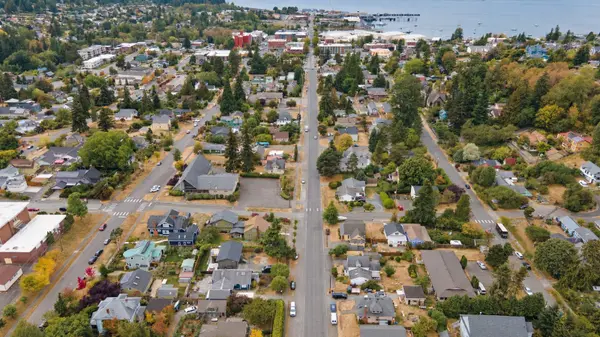
The Lettered Streets is a historic neighborhood immediately north of downtown Bellingham, named for its A-through-J street grid. Platted in the 1890s and early 1900s as a middle-class district beside the young city's core, it holds some of the oldest surviving buildings in Washington, and today mixes small older homes, cottages, and low-rise apartments within walking distance of downtown.
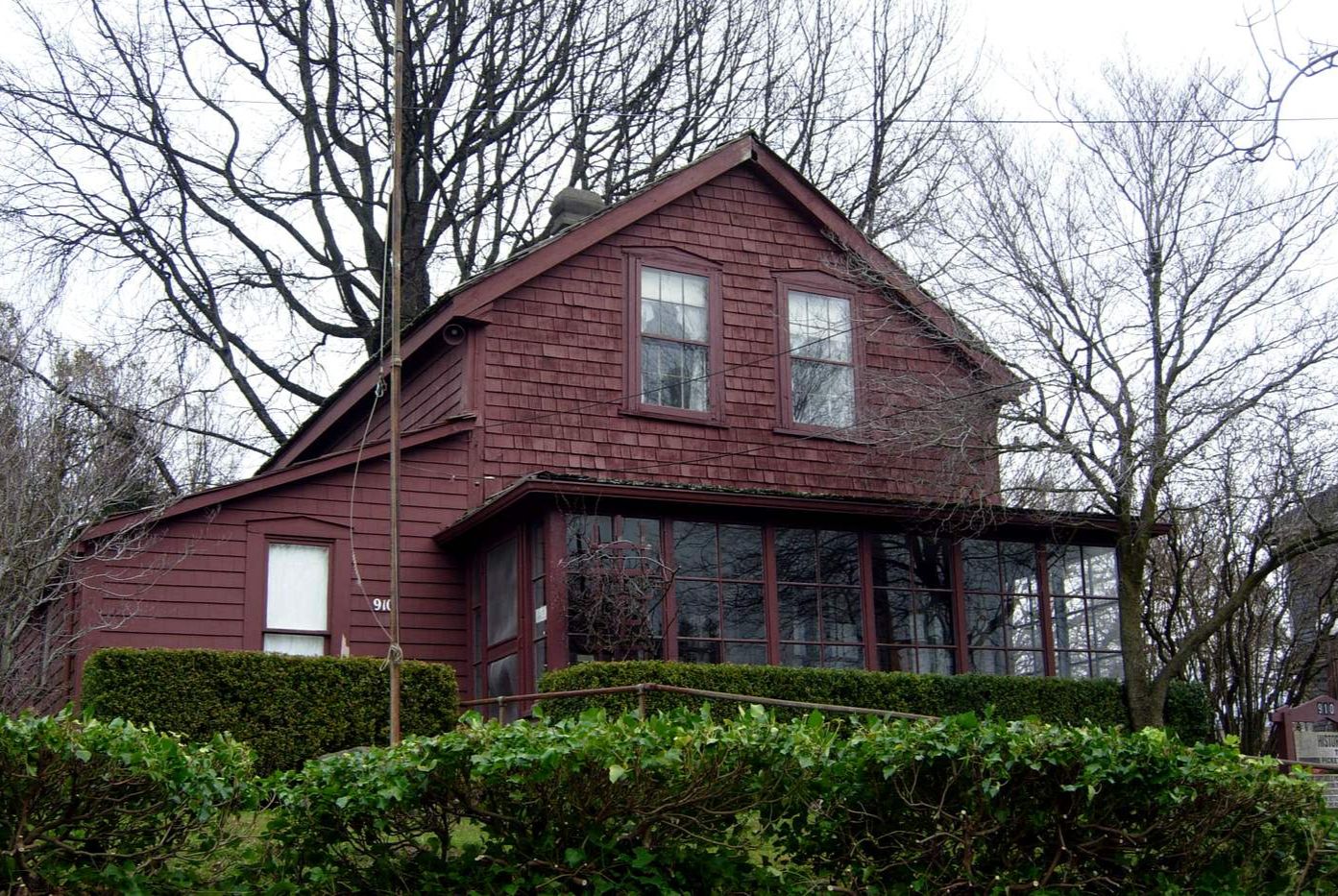
The 1856 Pickett House on Bancroft Street — the oldest house in Bellingham, and a Lettered Streets address. Photo adapted from Benjamin Cody, CC BY-SA 3.0.
What's in this guide
- Where the Lettered Streets actually is
- Why it's called the Lettered Streets
- Sawmills, a courthouse, and a comeback
- The Cissna Cottages: a district inside a district
- The homes: what you're actually buying
- What homes cost here in 2026
- Parks, trails, and getting around
- Schools and civic anchors
- What's changing next door
- Is it right for you?
- Frequently asked questions
Where is the Lettered Streets neighborhood in Bellingham?
It sits directly north of downtown Bellingham, wedged between the waterfront and the hill neighborhoods above it. The City of Bellingham's neighborhood plan describes Roeder Avenue, Broadway, and Cornwall Avenue as its edges, with Maritime Heritage Park on Whatcom Creek forming the southern boundary.
The practical version: if you stand on the corner of Holly and Astor, you are about a five-minute walk from downtown restaurants and roughly the same distance from a salmon hatchery. That compression — dense old housing, working waterfront, and a city center all inside a few blocks — is the whole character of the place.
| Boundary / anchor | What's there |
|---|---|
| South — Whatcom Creek | Maritime Heritage Park, salmon hatchery, downtown beyond |
| West — Roeder Avenue | Old Town, the working waterfront, marine businesses |
| East — Broadway / Cornwall | Whatcom Middle School and Battersby Field |
| North | Columbia neighborhood and Elizabeth Park just beyond |
Why is it called the Lettered Streets?
Because the streets are literally letters. A Street, B Street, C Street and onward through J run lengthwise through the grid, a plainspoken naming convention from an era when Bellingham was still four separate towns trying to become one city. Cross streets carry names — Dupont, Bancroft, Astor, Girard — but the spine of the neighborhood is the alphabet.
I like showing buyers this neighborhood partly because the grid does something useful: it makes an unfamiliar city instantly legible. You never really get lost in the Lettered Streets. You just count.
Sawmills, a courthouse, and a comeback
The lower falls on Whatcom Creek powered the sawmills that drew the first settlers to the town of Whatcom in the 1850s, according to the City of Bellingham. Two survivors from that first decade are still standing in the neighborhood: the Pickett House at 910 Bancroft, and a brick building in the 1300 block of E Street.
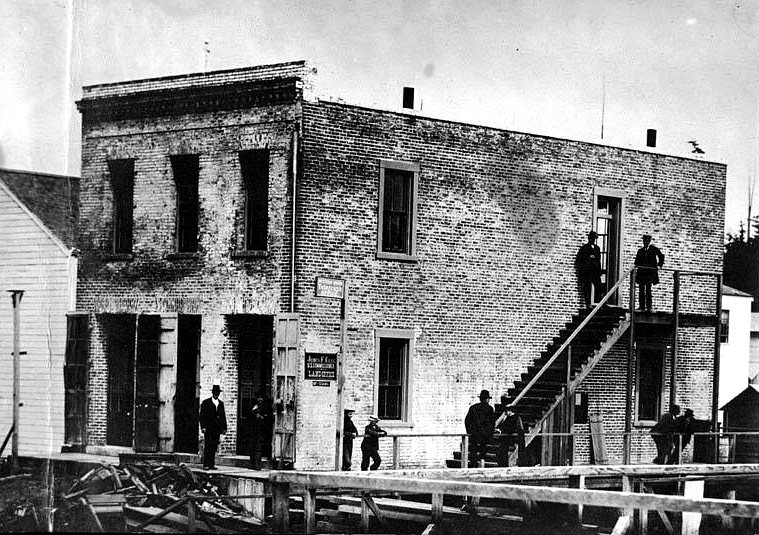
The E Street brick building, photographed around 1895. Built in 1858 and sold to Whatcom County in 1863 for use as a courthouse. Washington State Archives, public domain.
That E Street building deserves more attention than it gets. It went up in 1858 for the firm of T.G. Richards and Co., and in 1863 the county bought it for use as a courthouse. It is one of the oldest brick buildings in the state — and it is sitting on an ordinary residential block that most people drive past without a glance.
The bulk of what you see today, though, went up in the late 1890s and early 1900s, when the area filled in as a middle-class district next to the city's downtown. Four Lettered Streets properties are on the National Register: the Great Northern Depot (1927), the Aftermath Clubhouse (1914), the Roth Block (1890), and the First Christian Church site at Girard and A Streets.
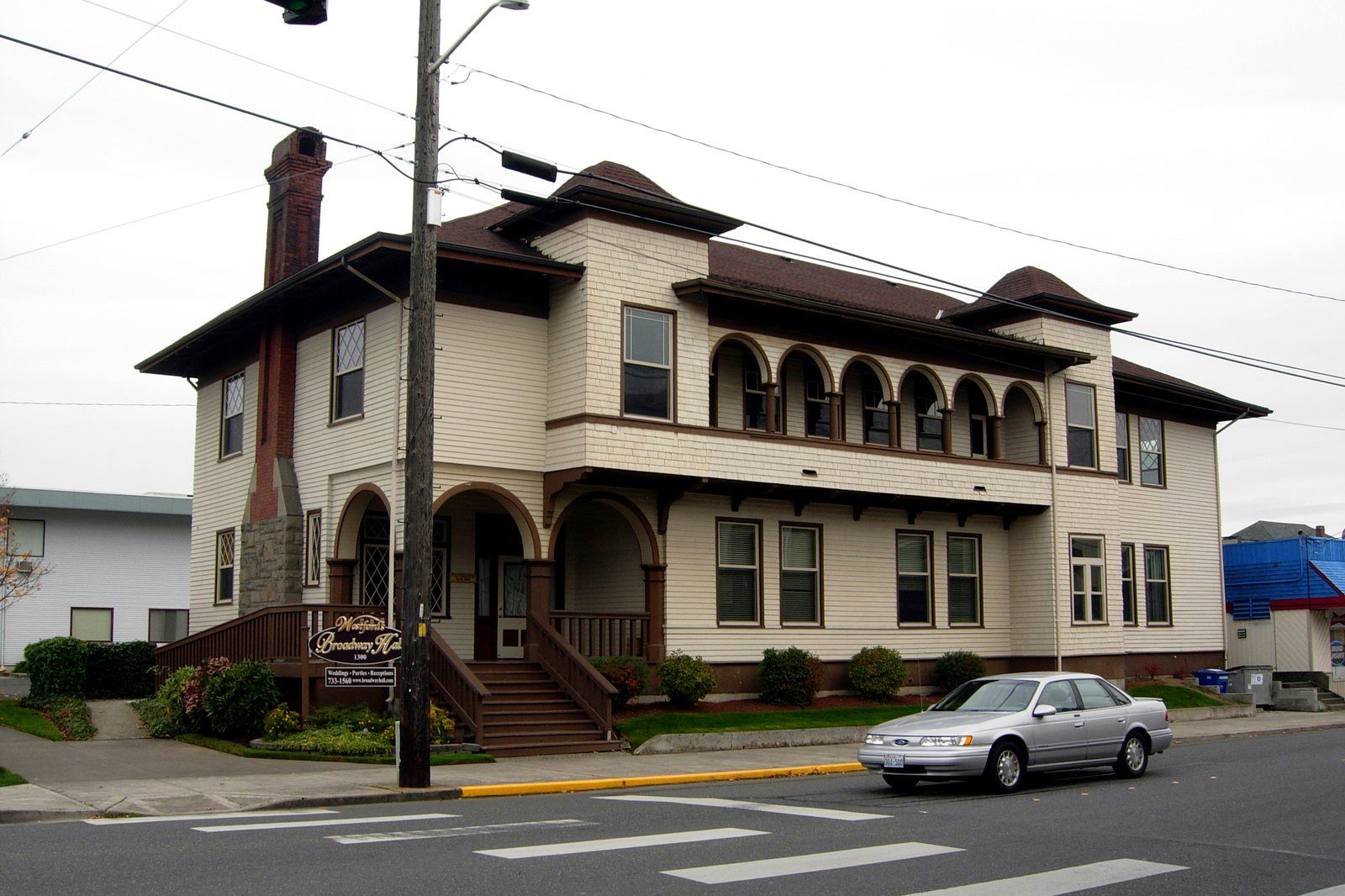
The Aftermath Clubhouse, built in 1914 and listed on the National Register. Photo adapted from Benjamin Cody, CC BY-SA 3.0.
The part of the story buyers rarely hear is the 1960s. The neighborhood ran down badly. What turned it around was unglamorous and local: residents used Community Development Block Grant money to put in new streets, sidewalks, sewer and water lines, and street trees, and to retrofit hundreds of homes. The Lettered Streets you can buy into today exists because people fixed it on purpose, block by block.
The Cissna Cottages: a district inside a district
Here is my favorite detail in the whole neighborhood. Tucked inside the Lettered Streets is the Cissna Cottages Historic District — one of eight National Register districts in Bellingham, and easily the smallest. It covers one block plus two lots, developed by Charles Cissna between 1900 and 1904.
What makes it distinctive isn't just the cottages. It's the street grid: this pocket was platted parallel to the bay, out of alignment with everything around it. Once you notice the seam where one grid meets the other, you can't unsee it. It's a fossil of how Bellingham was assembled out of competing town plats.
Worth knowing: the Lettered Streets was one of three neighborhoods — with South Hill and York — chosen for the City's 2007–2009 Preserve America historic resource survey. That means unusually good public documentation of construction dates and architectural styles here, which is genuinely useful when you're evaluating an older house. Read my South Hill neighborhood guide for the companion district.
The homes: what you're actually buying
The City describes today's mix as single-family homes, small apartment buildings, offices in older homes and newer buildings, and small parks. In practice, most of what trades here is a modest turn-of-the-century house on a small lot — cottages, foursquares, and early bungalows, frequently under 1,500 square feet, often on a 5,000-square-foot lot or less.
What that means for you, honestly:
- Expect original construction quirks. Knob-and-tube remnants, undersized panels, post-and-pier foundations, and 1920s plumbing all show up. Budget for an inspection with someone who works on old houses regularly.
- Parking is a real negotiation point. Many of these homes predate the garage. Off-street parking is a genuine value driver here in a way it isn't in newer neighborhoods.
- Lot lines can be odd. Between the competing plats and a century of subdividing, surveys matter more than usual.
- Mixed-use is a feature, not a flaw. Small apartment buildings and converted offices sit next to single-family homes. If you want strict residential uniformity, this isn't that neighborhood.
What do homes cost in the Lettered Streets in 2026?
Here's where I have to be careful, because the honest answer is "the sample is tiny." Redfin puts the median sale price at about $685,000 over the three months ending May 2026, up 22.2% year over year, on five sales in May. Homes averaged 28 days on market, up from 12 a year earlier.
| Metric (3 mo. ending May 2026) | Lettered Streets | Change vs. last year |
|---|---|---|
| Median sale price | $685,000 | +22.2% |
| Median price per sq. ft. | $437 | −8.0% |
| Median days on market | 28 | up from 12 |
| Homes sold (May) | 5 | down from 6 |
Source: Redfin neighborhood data, three months ending May 2026.
Now look at those two numbers together, because they tell you something a headline can't. The median sale price rose 22% while the median price per square foot fell 8%. That is not a market where everything got 22% more expensive. That's a market where a handful of larger houses happened to sell. With five transactions in a month, one big sale swings the median.
The live-listing picture runs higher still: current inventory on my Lettered Streets area page shows a median list price around $832,500 across 14 listings. List prices and closed sales are different animals, and asking prices in a small historic neighborhood are especially prone to optimism.
For context, Redfin put the Bellingham citywide median at about $630,000 over the same window. So the Lettered Streets is currently pricing at or above the city median — which surprises people who assume "small old houses near downtown" means "cheap."
Thinking about selling here? Neighborhoods this small are exactly where automated estimates go wrong — an algorithm can't tell a restored 1902 cottage from a deferred-maintenance one on the same block. Start with my free home valuation tool, then let's talk about what your specific house is worth.
Parks, trails, and getting around
Maritime Heritage Park anchors the southern edge on Whatcom Creek. It's a multi-use park, a fish hatchery, and an educational facility all at once — and each fall you can stand there and watch salmon return. Having that at the end of your block, four blocks from a downtown bar, is not a normal amenity.
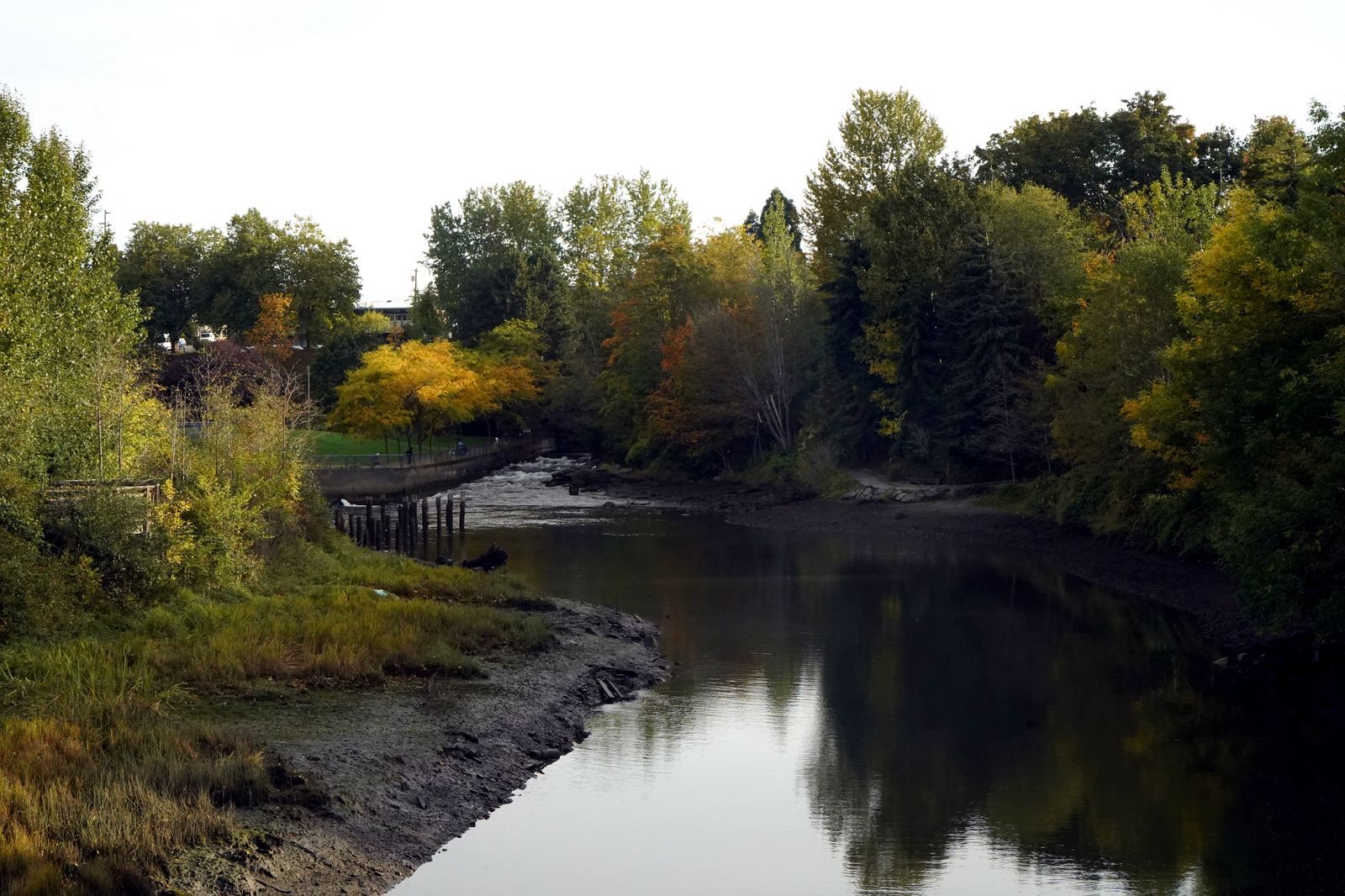
Whatcom Creek at Maritime Heritage Park, the neighborhood's southern edge. Photo adapted from Allyn, CC BY-SA 4.0.
The nine-block Old Village Trail runs through the neighborhood as a pedestrian connection, stitching blocks together that the street grid otherwise separates. Just north, in the neighboring Columbia neighborhood, Elizabeth Park is the oldest park in Whatcom County — 4.5 acres donated by Henry Roeder in 1883 and named in 1912 for his wife, Mary Elizabeth Austin Roeder. It isn't technically in the Lettered Streets, but plenty of residents treat it as their park.
On foot, downtown is the obvious draw. Most of the neighborhood is a genuine walk — not a "walkable" marketing claim — to restaurants, the library, and the Bellingham Farmers Market. Interstate 5 access is a few minutes east.
Schools and civic anchors
Whatcom Middle School and the Battersby Field complex sit on the neighborhood's eastern side, and the school itself is one of the better stories in Bellingham. Built in 1903, it's the oldest school building in the district. A fire gutted it on November 5, 2009, and most people assumed that was the end of it. The district rebuilt it instead — recreating the historic exterior — and it reopened on September 1, 2011, a year ahead of schedule.
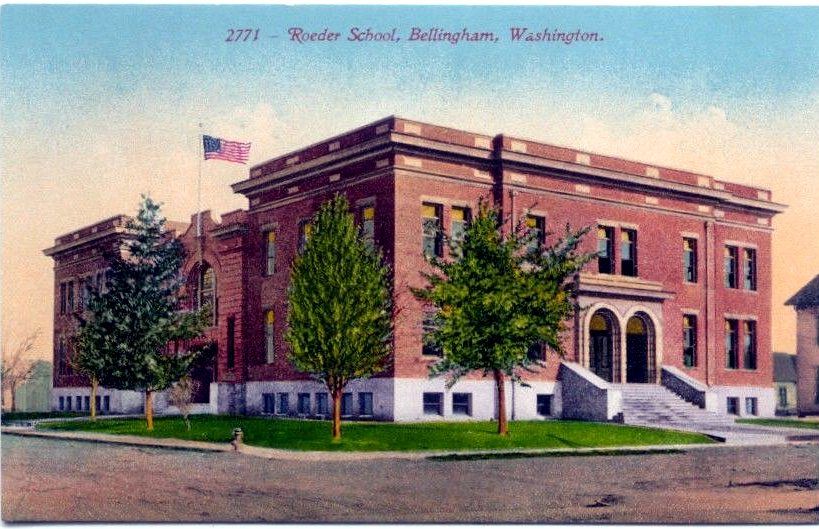
Roeder School on Dupont Street, pictured on a 1910s postcard. The building still stands and now houses Bellingham School District offices. Public domain.
The 1908 Roeder School is still on Dupont Street too, serving as school district offices these days. Other locally significant buildings include Unity Church (1884), the commercial row along West Holly, and the 1906 building at I and Astor that started life as the Baptist School of Industries. Attendance boundaries change, so confirm current assignments with Bellingham Public Schools before you buy on that basis.
What's changing next door
The biggest variable for this neighborhood isn't inside it — it's Old Town, immediately to the southwest, which the City is working to convert from underused industrial land into a denser residential and commercial district. Since 2023 the new Lighthouse Mission shelter has been completed, Holly Street storefronts have been renovated, and construction has started on the first new residential building: 84 market-rate apartments with commercial space on Astor Street. A $5 million state grant is going toward a 74-unit complex for seniors.
If you're buying here, treat Old Town as the thing to watch. Redevelopment on that scale, that close, will affect traffic, retail, and values in both directions. I'd rather you go in with your eyes open than be surprised in three years.
Is the Lettered Streets right for you?
| It fits well if you want… | Look elsewhere if you want… |
|---|---|
| To walk to downtown Bellingham daily | A large lot or acreage |
| Period architecture and a restoration project | Move-in-ready modern construction |
| A compact, low-maintenance yard | A three-car garage and wide driveway |
| A mix of housing types on your block | Uniform, single-use residential streets |
Ready to look at the Lettered Streets?
I'm a Whatcom County agent and I've walked these blocks plenty. If an old house here appeals to you, the difference between a great buy and an expensive lesson is usually what you learn before you write the offer.
→ Browse live Lettered Streets listings
Frequently asked questions
Why is it called the Lettered Streets?
The neighborhood's main streets are named with letters — A Street through J Street — running lengthwise through its grid. The name is purely descriptive and dates to the original platting of the area in the late 1800s.
Is the Lettered Streets a historic district?
Not as a whole. The Cissna Cottages Historic District, a one-block-plus area developed between 1900 and 1904, sits inside the larger neighborhood and is on the National Register. Several individual Lettered Streets buildings are also listed, including the Aftermath Clubhouse, the Roth Block, and the Great Northern Depot.
How old are the homes in the Lettered Streets?
Most were built in the late 1890s and early 1900s, when the area filled in as a middle-class neighborhood next to downtown. A few structures are far older — the Pickett House dates to 1856 and the E Street brick building to 1858.
Can you walk to downtown Bellingham from the Lettered Streets?
Yes. The neighborhood begins where downtown ends, at Whatcom Creek and Maritime Heritage Park, so most addresses are a short walk from downtown restaurants, the library, and the Bellingham Farmers Market.
What should I check before buying an older home there?
Have an inspector who regularly works on pre-1930 houses look at the foundation, electrical panel and wiring, plumbing supply lines, and drainage. Ask about off-street parking and get a current survey — overlapping historic plats make lot lines less predictable here than in newer neighborhoods.
About the author
Tommy Mutchler is a real estate agent with Real Broker LLC serving Whatcom and Skagit County, Washington, from Ferndale. He writes neighborhood guides like this one to help buyers and sellers understand what's actually happening on the ground, block by block. Learn more about Tommy or get a home valuation.
Categories
Recent Posts



Local Bellingham Agent
Tommy Mutchler
Thinking about a move in Whatcom County?
I'll help you stay competitive and make your next move feel easy. Book a free, no-pressure Home Goals call and leave with a clear plan.
Connect With Tommy15 minutes • No obligation
GET MORE INFORMATION